
The agriculture sector is the largest economic sector in Somalia, not only in terms of covering the food needs for the most of its population, but also in terms of generating revenue and making the main livelihoods of the rural society through crop sales and agricultural labor opportunities. It also contributes the largest portion of the national GDP from domestic distribution and exports to other parts of the world. Constant agricultural growth is very important to enhancing the living standards of our people as well as making quick economic growth. However, despite the importance of the agricultural sector in Somalia‘s economy, the farming sector has been for many years mainly small scale, poorly mechanized and most of them are rain-fed . In addition to this, official support from the government and infrastructure have been nearly absent.
Rain-fed Agriculture in Somalia
Rain-fed agriculture plays an important role in most agricultural regions in Africa, including Somalia. Its importance differs regionally and creates the main income for poor communities in developing countries. According to the statistics from FAOSTAT (2005), in sub-Saharan Africa, including Somalia, more than 85% of the farmland is rain-fed, while rain-fed farms in Latin America are almost 90%, and for South and East Asia about 60 to 65%. Despite the efforts from governments and other agencies to improve productivity of the rain-fed agriculture and enhance environmental conditions in many developing countries, a great number of poor families in Africa and Asia still face poverty, hunger, food insecurity and malnutrition.
The economy in Somalia is dominated by agriculture (farming and livestock) as the main source of livelihood in most parts of the country. Rain-fed crop production is widely practiced, and represents the largest portion of the farmland, but is an effective only in the areas which have marginally a higher rainfall. The existence of substantial opportunities for crop production lies under irrigation along the Jubba and Shabelle rivers basins. Though, even under maximum irrigation improvement before the civil war, Somalia still facing a food deficit problem, as the agriculture, especially the rain-fed, is vulnerable to a higher risk. During pre-conflict time, the production of exported crops such as banana, sesame and grapefruits achieved under irrigation in the lower and Middle Shabelle and Juba valleys.
Rain-fed Agriculture and Climate Change Effects in Lower Shabelle
Agriculture is widely dependent upon the weather and climate in order to produce the food and resources that are essential to sustain human life. Not amazingly, rain-fed agriculture is considered to be an economic activity that is highly probable to be vulnerable to climate change and global warming. Climate change and Global warming affect seriously farming practices, crop growth and quality, as well as pest control and the varieties of crops and animals that are raised in specific areas.
Climate change impacts and influences to the agriculture sector are among the major and best documented. Most studies suggest that crop productions may decrease if the same crops are grown in the same areas under various climate change conditions. Even with adaptation, studies conducted in Africa and South America state that global warming will reduce farm net revenues. Further, change in climate will have different impacts on different countries (Wang, Mendelsohn, Dinar, Huang, Rozelle, & Zhang, 2009).
In Africa, especially in Somalia, as the rain-fed method of farming dominates in the agriculture sector, the ability to buffer and benefit from changes in rainfall levels is relatively limited, and makes farmers subjected to a high degree of vulnerability. For some regions in Somalia, including Lower Shabelle region, the dangers of seasonal droughts caused by climate change are often exhibit causing decreases of rainfall and temperature increase, which in turn contribute emerging a food shortage problem. Droughts are harmful because of the long-term shortage of water available to the plants and animals, and caused some of the more severe famines in Somalia. Heat waves can cause extreme heat stress in crops, which can limit productions. Recurrent droughts and its severity within the valleys are also expected to increase with negative impacts on infrastructure, rural businesses and greater loss of biodiversity and could increase the speed to generating desertification.
In order to get a knowledge about how the climate change affected the production of rain-fed farms in Lower Shabelle region, 15 farmers, each of them with a minimum of 15 years of experience, have been asked about their annual crop production volumes (in barrels) in the past 10 years . Most farmers do not record their exact crop productions, so, it is difficult to get a large number of respondents who can memorise their actual production volumes, but few of them can give an approximation volume of their past productions.
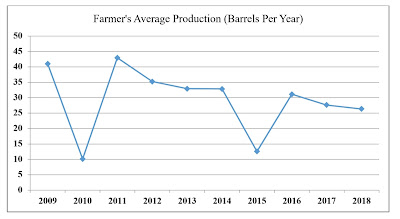
As the graph shows, from 2009, crop productions are in a declining condition year after year, this negative trend tells more about the serious effects of the climate change and global warming on the rain-fed farms crop production. 2010 and 2015 were the most severe seasons in terms of crop productions decline, because of the droughts witnessed in the southern parts of Somalia. These droughts affected both rain-fed and irrigated farms in Lower Shabelle region, though rain-fed farms were the most affected.
How Investors Neglected Rain-Fed Agriculture in Lower Shabelle Region
Agricultural investments play an important role in developing the agricultural output in developing countries. Finance is an important for any business, and so for the agriculture sector, accessing enough funds and finance is critical for the growth and the development of the agriculture sector. Not amazingly, as the agriculture is considered to be an economic activity that is highly probable to be vulnerable to climate change, investors and financial institutions are aware to accept the risks in the sector. The role of commercial banks financing in the agriculture is very low, and focused only investing in the irrigated farms, rain-fed farms that produce much of the food consumed locally by poor communities are neglected because of the higher risk.
As temperatures rise dramatically season after season, precipitation patterns change unpredictably, and increased heat also increases the severity and prolongation of drought, it is difficult to encourage investors to fund in the rain-fed farms. The worst case scenario, even some rain-fed farmers in Lower Shabelle region themselves are not willing to fund their farm fearing that they may lose their money because of unexpected losses and the higher risks in the agriculture sector recent years. Lack of access to sufficient funds in the agriculture sector is consistently cited in most regions in Somalia, not only in Lower Shabelle region, and this causes setbacks in the economy of the country. With the existence of this problem, it is not strange to see most banks and investors in Somalia often prefer funding in the irrigated farms rather than the rain-fed because of the lower risk.
Conclusion
Climate change has serious impacts on the agriculture in general, especially in the rain-fed agriculture. The average temperatures in the agriculture regions increasing dramatically, water used for irrigation often end up evaporating due to the extremely heat, and crops are dying. The impact of climate change has also caused a problem of neglecting the agriculture, as agricultural investments declined clearly recent years. Agricultural stakeholders, investors, banks and other organizations do not intend funding rain-fed agriculture due to the higher risk, with financing rain-fed farms have become a difficult decision due to climate change effects.
The negligence of rain-fed agriculture in Lower Shabelle region is causing local farmers to struggle to get their daily livelihood, as most of the people in the region rely on the agriculture, especially the rain-fed, as their basic source of income. Agriculture is extremely vulnerable to several factors, higher temperatures actually reduce yields of necessary crops, changes in rainfall patterns increase the probability of short-run crop failures and long-run production declines. So, it is easy to understand why most financial institutions and other investors in Somalia to be more aware to accept the risks in the rain-fed agriculture.
Recommendations
As the existence of climate change problems in the farming sector could make it difficult to invest in, it is necessary to think about how to solve this problem. To eliminate risks from the climate change in the rain-fed agriculture is not an easy task, and need a collaboration between both the government and agricultural stakeholders themselves. In order to reduce risks from the climate change effects in the rain-fed agriculture, this study recommends:
- The government should establish strategies to combat climate change effects in order to improve the agriculture. Such as the reduction of industry wastes and toxic gases emissions, improvement of separation, and eliminating deforestation.
- Increasing research in the field of plant protection strategies and devising varieties that bear high temperatures and droughts.
- Educating the farmers and training them on how to adapt the cultivation of different agricultural crops under the current and expected climate conditions.
- Due to the higher risk in the agricultural sector in Somalia, the government should grant guaranties such as subsidies to commercial banks to motivate them to grant funds and micro-finance to local farmers.
Great article, and very informative.